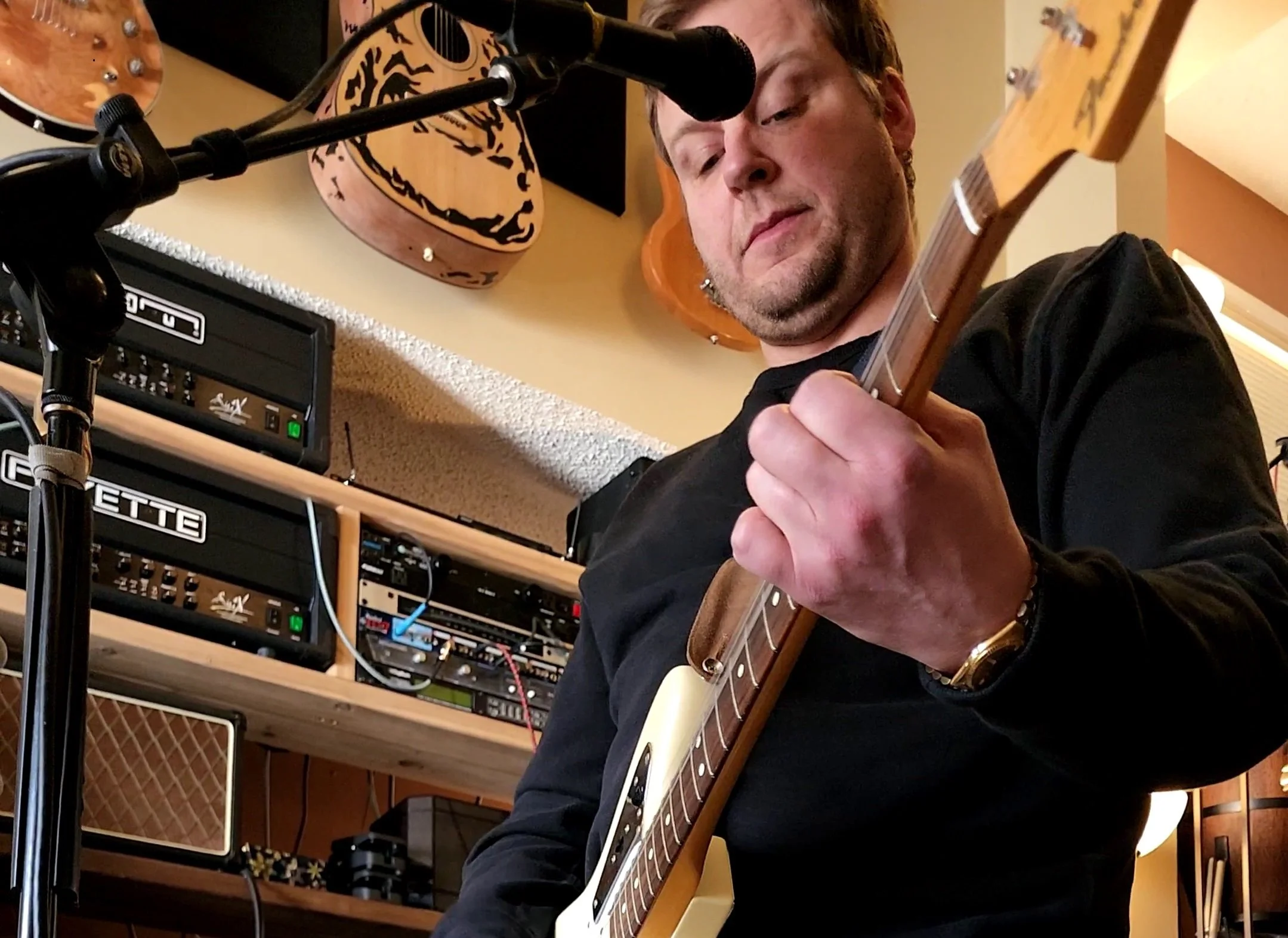
"Liminal Bridges" by Delphi Lights has around 60 individual guitar tracks. You'd never know it. It still sounds raw, natural and indie rock, which is exactly what Darren asked for.
That's what a good producer does. It isn't just pressing record. It's understanding what you're going for so well that you can take it further than you could on your own. Here's what that looked like on a five song project I produced, recorded and mixed for Delphi Lights. We released all five songs as singles, which is the best way to get the most out of a recording investment.
FINDING THE RIGHT FIT
Darren first reached out about a year before we started production. He really cares about his music, and he was looking for the right fit. We talked on and off over that year, and I gave him advice along the way.
We definitely had aligned values. But what made the difference was that, after all those conversations, he believed I understood his music and could get him the results he was after. So he decided I was the right producer for his EP.
That's my advice to any band looking for a producer. Take your time and talk to them first. Don't pick someone because they're the cheapest or the closest. You'd never buy your main guitar just because it's the cheapest one on the wall, or book your release show at a venue just because it's down the street. Your record deserves the same care. It's a big investment, and it's going to represent you for a long time. Make sure your producer understands your music, shares your values, and can actually deliver what they say.
IT STARTS BEFORE ANYONE PLAYS A NOTE
Once we committed, we got into pre-production. We spent a lot of time on the phone talking about the sounds he wanted, and he sent me his demos so I could hear where the songs were headed.
I realized a long time ago that describing sound with words is like trying to describe colours. Words like "fat" or "punchy" mean something different to everyone. The best way to communicate a sound is with actual sounds.
So I set up a shared Spotify playlist where artists add songs they love and tell me what they like about each one. It doesn't have to be the whole track. It might be the snare on one song or the vocal treatment on another. Once I can hear it, I'm in the ballpark.
I'm not trying to copy the snare from song A or song B. The reference shows me the tonal character they're after. From there, I bring my own experience, taste and artistic licence, and sculpt it for the track we're working on. Sometimes it ends up a little different from what they pictured, but it works, because it always comes down to what's best for the song. And with an audible reference to start from, I can get dialed in very quickly.
Every production I do is bespoke. It's unique to that artist and that song. The goal is never to recreate another project. It's to help them sound as much like themselves as possible.
To Darren's credit, he was one of the most focused artists I've worked with when it came to explaining what he wanted. His brief was simple: keep it raw, natural and indie rock, and don't overproduce it. My challenge was keeping that feel while tightening everything up so it sounded professional and commercially viable. Indie rock should feel real, but real doesn't mean sloppy.
That prep mattered, because he was only in town for six days.
THE MAIN PARTS IN SIX DAYS
We recorded all the main parts in those six days: guitars, vocals and bass for five songs. That takes a rigorous, efficient process. I programmed the drums afterward. Because I already knew the sound he wanted, we could dial in tones fast. Once the sound was there, we just went to town.
The key was capturing everything I needed in that window. Once an artist is back home or across the country, you can't just call them back in tomorrow. Darren did come back later for a couple of sessions to add backing vocals and a few changes, but everything the songs needed was already captured.
He hadn't played some of these songs in a while, and there wasn't much time to practise. That's not ideal. I always prefer artists come in rehearsed. But we were both focused, we both knew the end result we were after, and his performances were great. It wasn't about recording a million takes and using two. We got the sounds and we got the performances.
Were they perfect? No. They didn't need to be. That's where the studio comes in. In post, I can tighten parts up and align things in ways you can't in a live performance. Ideally, the less editing the better. But it's part of the process, not fixing someone's problems, and it's a big reason to work with an experienced producer.
Not everything was planned, though. Some of the bass lines needed work, so we wrote parts in the studio that suited the songs better than the demos. I played bass on "Foreign Familiar" and "Your Agency," and wrote one of the bass lines. Sometimes the best ideas happen in the room, and having the budget to explore them makes a real difference to the final product.
INTENSE, BUT WORTH IT
Those six days were grueling. Marathon days, back to back, with a lot riding on every session. It was the good kind of pressure, but it took everything we had, mentally, physically and emotionally. Music takes a lot of emotional energy. Darren pours himself into it, and so do I.
We pushed each other hard. I asked for take after take, and there were moments of friction. That's normal when two people care that much about the result. Darren dug in and delivered, and we came out the other side with a record we're both proud of.
"The recording process was quite streamlined. We were frantically focused for the majority of the sessions."
— Darren Long, Delphi Lights
We're still good friends, too. We golf together, and I've worked on more of his music since, including his latest release.
That's worth thinking about when you choose a producer. Can you spend long, intense days in a room with this person, get the work done, and still look forward to coming back tomorrow?
LAYERING GUITARS FOR TEXTURE
In rock and indie rock, guitar layering isn't optional. In any guitar heavy genre, layers are what create the depth and space that make a record feel big. I love that part of the process, and I had a clear idea of the textures I wanted. We layered heavily on every song on the record, and "Liminal Bridges" is the extreme example.
We tried a few amps, including a Fender Deluxe, but we kept coming back to a Vox AC30 head through a matched vintage 4x12 cab. It sounded big, and we loved the overall tone. So we locked in settings for different tones and changed the gain to get more or less distortion depending on the part. One amp, many tones.
The rest of the variety came from the guitars, pickups and mics. We switched between the cream American Telecaster my dad left me, my Washburn Pilsen Idol and Darren's Fender Jaguar, and changed pickup settings from part to part. On the cab, I moved between a Shure SM57, an AKG 414 and sE ribbons. I also set up a pair of vintage Reslo ribbons a few feet back. Those are the same British mics the BBC and the early Beatles used, and they picked up a lot of really nice, warm low end.
That's how "Liminal Bridges" ended up with around 60 guitar tracks, counting solos and interlude parts. Not every song needs that many. But this one had a lot of different parts, and we wanted real depth. On "Soul of Gaia," I added acoustic guitar layers for depth and space.
And none of it sounds overproduced. When layering is done right, you don't hear 60 guitars. You just hear a song that feels bigger.
ADDING TO THE SONG, NOT TAKING IT OVER
What I love about working with Darren is that he knew exactly what he wanted the finished product to sound like, and he knew he needed help getting there. That let me steer us there quickly, without a lot of back and forth. He was also willing to bend when I had a good idea. He made space for me to contribute, and that's when a collaboration really works.
Because I understood his vision so well, I could build on what he was already doing in ways I don't think he knew were possible.
On "Liminal Bridges," I added something to every part of the song. One of my favourites is a descending four note arpeggio, higher up on the guitar, that plays against his chords. It's a small part, but it gives the song a whole different colour. The vocal call and response was my idea too, and it's one of the coolest moments on the track.
I also brought the vocal stacks, harmonies and chorus ideas. Those were pivotal to the sound of the record, and they're something a producer can bring that's hard to do on your own.
BRINGING THE VOCALS FORWARD
On his demos, Darren's vocals sat back under a lot of reverb. But I heard more in his voice than the demos were showing, so in the first mixes I brought the vocals up front with a more modern treatment.
"I was reluctant at first, eventually it won me over. With Liminal in particular."
— Darren Long, Delphi Lights
That's the kind of call a producer is there to make: hear what the song needs, try it, and let the artist hear the difference.
THE BIGGEST MISTAKE BANDS MAKE
The biggest mistake is trying to do everything on your own first and only bringing in a producer at the end.
Come in rehearsed. Know your songs and be able to play them. But don't spend months locking in your tones and arrangements for a release before we've talked. A producer can help shape your sound and get you to your vision a lot faster.
And remember, a record isn't your live set. It's great for guitar players to have their own tones, but a lot of what we do in the studio isn't something you'd do on stage. The earlier a producer is involved, the more they can help.
FREQUENTLY ASKED QUESTIONS
What does an indie rock producer actually do?
A producer shapes the sound and direction of your songs. That can mean pre-production, arrangement ideas, writing parts in the studio, dialing in tones, coaching performances, adding guitar layers and vocal harmonies, keeping the project on schedule and on budget, and helping make the final call on what serves the music.
When should a band bring in a producer?
Before you lock down tones and arrangements. Have your songs written and rehearsed, then bring a producer in while there's still room to shape the sound. That's when they can add the most.
Can you record an EP in a short trip to Calgary?
Yes, with good pre-production. We recorded all the main parts of Delphi Lights' five songs in six days, because we'd planned the sounds ahead of time. Darren came back for a couple of shorter sessions afterward.
LOOKING FOR AN INDIE ROCK PRODUCER IN CALGARY?
I'm a musician myself, and I love supporting artists and our local scene. So invite me out to your jam session or your next live set. Hearing what you're doing right now gives me real context. To get where you want to go, you need to know where you are now. Once I understand both, I can build the map to get you there.
You can hear "Your Agency" and "Liminal Bridges" by Delphi Lights on our Studio Projects page. To see how we work with bands and artists, check out our music production page, or see how we helped Delphi Lights promote their single "Siren Shoreline" on our music marketing page.
We produce, record and mix at our recording studio in Calgary, and you can browse everything else we do on our studio services page. Heading in for the first time? Read Your First Time in a Recording Studio: What to Expect.
Questions first? Send us a message.