Most of the podcasts I hear that people record at home have the same two problems. The audio isn't great, and the show has no direction. Nobody planned anything. There's no script, no talking points, and the conversation just rambles.
The good news is both are easy to fix, and neither one starts with buying expensive gear.
THE BIGGEST MISTAKE ISN'T THE MIC
People blame their equipment, but the most common problem I hear is a lack of pre-production. Someone sits down, hits record and starts talking with no plan. An hour later there's no point, no structure and no reason for a listener to stick around.
A podcast isn't just rambling into a mic. You're asking people to give you their time, so you have to give them something worth it. That's what providing value means, and good, clean audio is part of it too, so listeners aren't distracted by noises or anything else that pulls them out of the conversation.
PLAN BEFORE YOU PRESS RECORD
Pick subjects people actually care about. Then do some planning. Have talking points, and at least a loose script or outline to follow. You don't have to read everything word for word, and you can ad lib here and there. You want the conversation to feel natural and organic, but with direction, purpose and intention. That's what lets you move through a conversation instead of rambling for hours.
If you have guests, research them and research the topic. Learn how to interview and how to tell a story. That's what turns a chat into an episode that's insightful, valuable and to the point.
GOOD SOUND IS MOSTLY TECHNIQUE
The mic, the room and the equipment allhave some effect. But what matters most is understanding signal to noise ratio and using proper gain staging and recording technique.
- Get your levels right at the source. Don't run your preamp way too low and then boost it later in your recorder or DAW. That just brings the noise up with it.
- Position your mics properly, and set them up so each mic rejects the other speakers as much as possible.
- Use a decent sounding room. Make some effort to dampen sound and control reflections. You don't want anything too big or echoey. If your space is bigger or more echoey than you'd like, get the speaker closer to the mic. That takes the room out of it. It's part of signal to noise ratio: the speaker's voice, which is the signal, needs to be louder than the ambient noise and anything else in the room.
- Getting closer does introduce something called proximity effect, which boosts the low end. So if you have a guest with a really deep voice, the RE20 might be a better choice than the SM7B, because it's designed to keep proximity effect to a minimum.
- Decent mic, good technique, good preamp. That combination beats an expensive mic used badly every time.
If you want more on getting clean levels at home, I go deeper on gain staging in Home Recording or Studio? What to Record Where.
YOU DON'T NEED EXPENSIVE GEAR
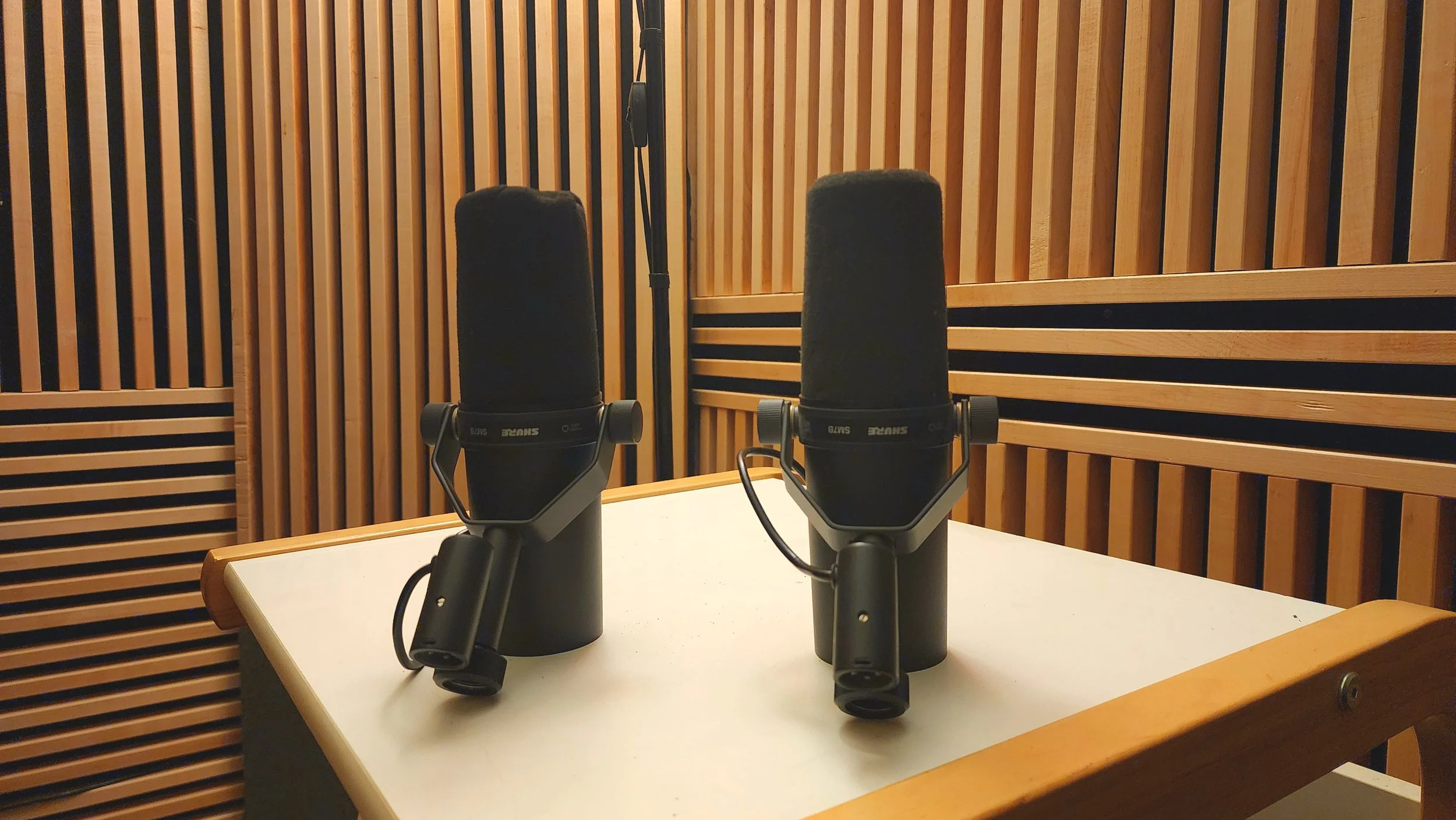
When people talk about expensive mics, they usually mean large diaphragm condensers built for recording singers, and those can run into the thousands, with vintage ones costing far more. You don't need any of that for a podcast. Broadcast mics like the Shure SM7B or Electro-Voice RE20 are decently priced and built for the human speaking voice. They're warm, they don't add a lot of coloration, and they capture speech clearly and intelligibly. They're cardioid, so their polar pattern focuses on the source, which is the person speaking into it, with strong rejection from the back. That keeps the other voices in the room out of each mic. They're what I use in our podcast lounge.
That's not to say you can't use them on singers or other sources. I do. Every mic has its own polar pattern and character, and that's what decides what you use it on. A singer with a really bright voice might not be the best fit for a bright condenser. Someone with a lot of plosives or mouth noise might need a mic that handles them better. Loud sources need a mic rated for higher SPL. So do your research on the mic itself. Learn to read the technical specifications and understand what they actually mean, and don't just buy into the marketing hype. If you're just running a podcast, you don't need to go that deep, but it's a good skill to have. If a mic goes down mid-session, you'll know what you can swap in.
When you're starting out, I'd spend more time learning the process and the techniques than spending money on gear. You can do a lot with fairly inexpensive equipment. But if you don't know how to use it, you could have the most expensive mics and cameras in the world and it's still going to sound and look bad.
I can capture good audio on inexpensive equipment, and it's not because of the gear. It's because I've spent years studying how to do it. I've learned proper mic technique. I understand what different pieces of gear can and can't do, and how to use them properly. And I've trained my ears to know what to listen for and what something should sound like, so I can capture the best possible source audio, whatever it is, and keep editing to a minimum. Video is the same. I can get good video out of a phone because I've taken the time to study composition, lighting and the principles of good filmmaking.
None of that works unless you understand the tools you're using and how to use them properly. So train your ears, trust your ears and know what to listen for. And get to know your own equipment: what each piece does, where its limits are, and how to get the most out of it.
GUESTS AND VIDEO
A solo podcast is a lot different from having guests. When you have people coming on, your job is to make them feel relaxed and comfortable, because relaxed guests give better conversations.
Part of that is the space. Keep it free of visual and audio distractions, so guests aren't overwhelmed by cables and mics in their face. But a lot of it is psychological. Greet them warmly. Offer them tea, coffee, water or whatever they'd like. Show them where the facilities are and give them a few minutes to get used to the space. Then get them settled in and ready for the conversation.
When we recorded the Ideal Completion Services podcast, we had five guests in the studio at once, all recorded together in our podcast lounge. Everyone sat in comfortable chairs, each on their own broadcast mic, like the SM7B and RE20, running into my BAE 1028 preamps, which are based on the classic Neve 1073. They're a little bougie for a podcast, but I have them, so I use them. The point is still the same: a decent mic into a good preamp, set up properly. I handled the recording, editing and mixing.
If you're shooting video, the space has to look good too. Light it well and take the time to make it look like a place people want to watch. We can record video podcasts here, and guests who can't make it in can join remotely by phone patch, Source-Connect, Zoom, Google Meet, Teams or whatever works for them. Just let us know ahead of time so we can set it up.
WHAT HAPPENS AFTER YOU STOP RECORDING
This is the part most new podcasters don't realize. There's a lot of post-production in a good episode:
- Editing the conversation so it moves
- Cleaning up noises, pops and any stray sounds you don't want in there
- EQ, compression, normalization and other processing so it sounds consistent
- Adding stingers, bumpers and music. Use royalty-free or properly licensed music, so you don't run into copyright problems.
- Adding chapter markers with timestamps, so listeners can jump to the parts of the conversation they want
It all takes time, and it's the difference between something that sounds homemade and something that sounds like a real show.
Already recorded an episode you think is ruined because the audio is bad? Don't scrap it yet. We offer audio cleanup and restoration, and we can often save recordings people think are lost.
FREQUENTLY ASKED QUESTIONS
What's the best mic for a podcast?
A broadcast dynamic mic like the Shure SM7B or Electro-Voice RE20. They're built for the speaking voice, they sound warm and clear, and their cardioid pattern rejects most of the rest of the room. Technique still matters more than the mic.
Do I need a studio to start a podcast?
No. Plan your episodes, use a decent sounding room, get close to the mic and set your levels properly. A studio helps most when you have guests, want video, or want proper editing and mixing. It also gives you a professional workflow, so you can focus on being the host or interviewer instead of the technical side, without spending years learning it all yourself. The technical side takes a lot to get right, so if you'd rather put your energy into the conversation, let us handle it.
Can I record a podcast with several guests at Frequency Studios?
Yes. We can record multiple guests at once. The Ideal Completion Services podcast had five guests in the lounge together. We can record video too, remote guests can join by phone, Source-Connect, Zoom, Google Meet or Teams, and we handle the recording, editing, mixing and production.
WANT HELP WITH YOUR PODCAST?
We record, edit, mix and produce podcasts at our recording studio in Calgary. We can also write and produce original music for your intro, outro and stingers, and help with bumpers and graphics. You can see what we do on our voice over, ADR and podcast recording page, check out the mics we use, or browse all our studio services.
Questions first? Send us a message.